
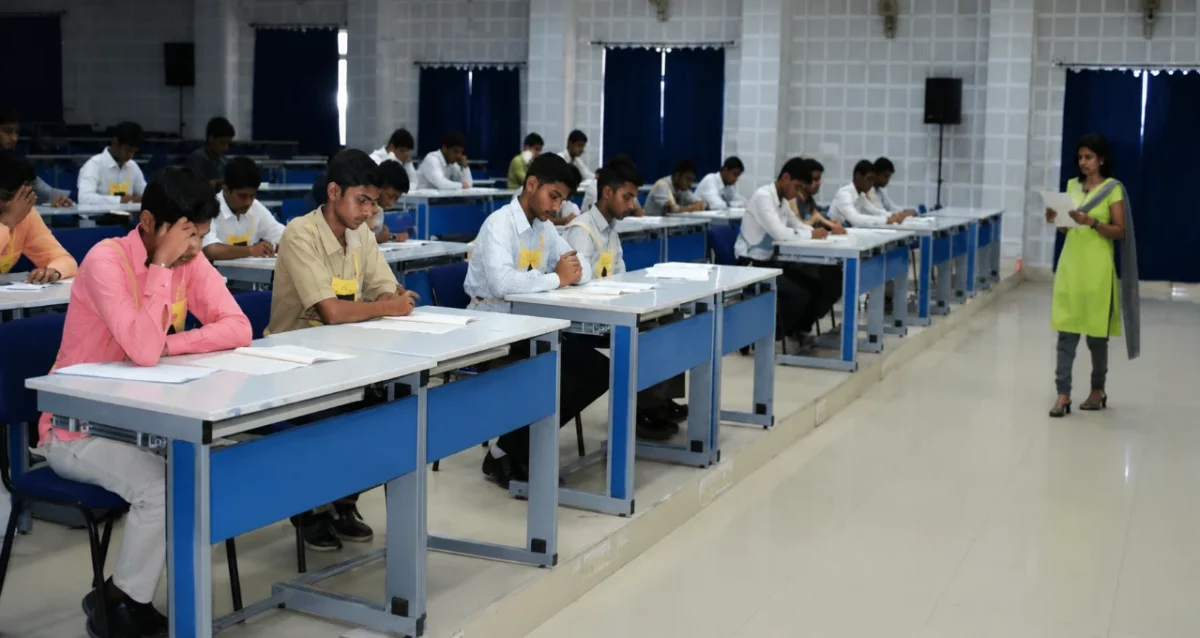
The Word Association Test (WAT) is the second psychological test conducted on Day 2 of the SSB interview (Stage 2), immediately after the Thematic Apperception Test (TAT). It is designed to reveal your natural thought process, personality traits, emotional stability, and Officer-Like Qualities (OLQs) under time pressure.

In WAT, 60 words are projected on a screen one after another. Each word remains visible for exactly 15 seconds. In that short window you must read the word, form an immediate idea, and write a complete, meaningful sentence. The entire test lasts 15 minutes with no pauses between words. Psychologists use these spontaneous responses to understand how you think in real life — your attitudes, values, problem-solving approach, and overall mindset.
Because the time is deliberately short, your first reaction comes out. That is why consistent practice and a positive mental framework matter more than memorising ready-made sentences.
Why WAT Matters
WAT helps the psychologist assess:
- Your natural associations and attitude under pressure
- Emotional maturity and optimism
- Clarity of thought and mental agility
- Leadership potential and practical approach to situations
- Consistency with responses in TAT, SRT, and Self-Description
There are no “right” or “wrong” answers in the conventional sense. What matters is the pattern of your thinking — whether it is constructive, action-oriented, and reflective of officer-like qualities.
Golden Tips to Tackle WAT Successfully
- Understand that the test reflects real-life reactions
Your responses show how you normally react to words and situations. A better understanding of your own personality (strengths, interests, fears, and weaknesses) through honest introspection helps you consciously develop a more positive and mature outlook. - Look carefully and stay focused
Each word is shown for only 15 seconds. Missing even one word can break your sequence and rhythm. Train yourself to read the word instantly and start writing without hesitation. - Form a positive idea first
The moment you see the word, your mind will form an image. Train yourself to turn that image into a constructive, practical, or solution-oriented thought. Personality decides whether the idea becomes positive or negative. - Write short, clear, and legible sentences
Aim for 8–14 words. Use simple language and clear handwriting. Incomplete or illegible responses reduce the quality of assessment. - There are no purely negative words
Every word can be approached positively. With practice, even words like “fear”, “failure”, “war”, or “death” can trigger constructive associations. - Practice regularly with a timer
Create your own response sheets. Practise sets of 60 words under strict 15-second timing. Over time, speed, positivity, and originality improve naturally. - Show Officer-Like Qualities naturally
Aim to reflect 6–8 OLQs across the 60 sentences (leadership, courage, responsibility, determination, teamwork, initiative, emotional stability, etc.). Do not force them; let them appear through action-oriented language. - Avoid over-use of defence-related sentences
Writing too many sentences about the Army, Navy, or Air Force looks artificial. Keep defence references limited and natural. - Do not write simple observations, idioms, quotations, or universal truths
Sentences like “Honesty is the best policy” or “Failure is the stepping stone to success” show lack of original thought. Psychologists look for your personal, practical association. - Minimise “I” and “Me”
Prefer third-person or general statements that reflect a broader, mature viewpoint. Excessive self-reference can appear self-centred. - Write from a human and practical point of view
Focus on behaviour, action, responsibility, and constructive outcomes rather than dictionary definitions. - Never memorise ready-made sentences
Memorised responses break the natural pattern the psychologist looks for and are easily detected.
How to Convert Negative Words into Positive Sentences
Negative words are deliberately included. The goal is not to avoid them but to transform the first negative image into a constructive idea.
Technique:
- Acknowledge the word
- Immediately shift focus to solution, strength, learning, protection, or positive outcome
- Write an action-oriented sentence
Examples of transformation:
| Word | Negative First Thought | Positive Sentence Example |
|---|---|---|
| Die | Death | Indian people are die-hard fans of cricket. / Agni-V makes India’s defence a deadly combination. |
| Defeat | Losing | A winner defeats his weaknesses through continuous effort. |
| Danger | Threat | Indian defence forces remain ready for dangerous situations. |
| Risk | Fear of loss | A leader takes calculated risks after proper assessment. |
| Worry | Anxiety | A fighter never worries about temporary failures. |
| War | Destruction | The Indian war of independence received tremendous public support. |
| Problem | Difficulty | Proper planning leads to easy solutions of problems. |
| Failure | Setback | Failures form the foundation of lasting success. |
| Challenge | Obstacle | Challenges increase a person’s abilities and resilience. |
| Difficult | Hard | Difficulties are overcome through patience and determination. |
| Fear | Weakness | Winners face their fears bravely and prepare thoroughly. |
| Aggressive | Anger | A good leader patiently handles aggressive situations in the team. |
| Confusion | Lack of clarity | Leaders maintain a clear vision even in confusion. |
| Weapon | Violence | A weapon is used for protection and security of the nation. |
| Hijack | Terror | Commandos are specially trained to handle hijack situations. |
| Anger | Loss of control | Controlling anger strengthens decision-making ability. |
| Pain | Suffering | Pain builds mental strength and character. |
| Alone | Isolation | Working alone develops self-reliance and focus. |
Practise converting 50–100 commonly used negative words regularly. After a few weeks the positive association becomes almost automatic.
More Sample WAT Responses
- Sacrifice – A person of strong morals never sacrifices his principles.
- Success – Consistent hard work and learning turn opportunities into success.
- Leader – A leader inspires and guides the team through personal example.
- Discipline – Discipline ensures correct action even without supervision.
- Teamwork – Teamwork achieves difficult goals through unity and coordination.
- Courage – Courage helps a person face challenges without hesitation.
- Responsibility – Accepting responsibility develops leadership qualities.
- Pressure – Pressure improves performance when handled with calm focus.
- Opportunity – Hard work converts every opportunity into concrete results.
- Friendship – True friendship is built on trust, respect, and mutual support.
Common Mistakes to Avoid
- Writing incomplete or very long sentences
- Using negative words such as “not”, “never”, “cannot” unnecessarily
- Giving moral lectures or advice
- Repeating the same idea or sentence structure
- Using passive voice excessively
- Writing dictionary-style definitions
- Panicking and leaving too many blanks (attempt at least 45–50 words)
Effective Practice Strategy
- Practise one full set of 60 words daily under timed conditions for at least 3–4 weeks before SSB.
- After writing, review your responses and rewrite weak ones in a more positive and action-oriented manner.
- Maintain a personal notebook of transformed negative words.
- Focus on consistency of positivity and OLQs rather than perfection of every single sentence.
- Combine WAT practice with TAT and SRT so that your overall psychological profile remains coherent.
Final Advice
WAT is not about literary brilliance or perfect English. It is about revealing a mature, positive, practical, and leadership-oriented personality under time constraint. The more you practise turning every word — especially the negative ones — into constructive thoughts, the more natural and confident your responses will become on the actual day.
With regular practice, honest self-observation, and a positive mindset, WAT becomes one of the strongest tools to showcase your suitability for the Armed Forces.
Best of luck to all defence aspirants. Stay positive, stay original, and keep practising.