
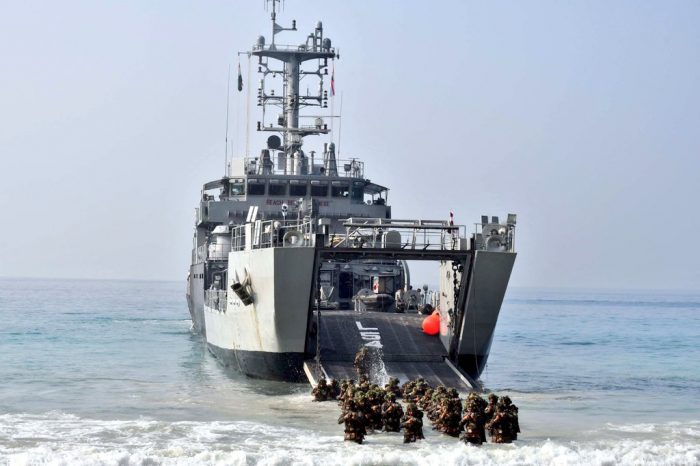
The Indian Navy is actively advancing its plans to acquire amphibious warships, also known as Landing Platform Docks (LPDs), which have been in the pipeline for over a decade. Recent developments indicate that India is collaborating with the United Kingdom to design and implement electric propulsion systems for these advanced naval vessels. This partnership will leverage the UK’s extensive shipbuilding experience, marking a significant leap for Indian shipbuilding capabilities and potentially paving the way for future collaborations in submarine development under the AUKUS agreement, as well as aircraft carrier projects.





To facilitate progress, a joint working group has been established, which includes a subordinate working group tasked with expediting the launch phase of the LPD project. Both nations are focusing on developing cutting-edge electric propulsion technology for the Indian Navy’s upcoming LPDs, which are slated for launch by 2030. Commodore Chris Saunders, the UK’s Defence Adviser in India, stated that the new designs will incorporate lessons learned from the UK’s advancement in various warships, including Type 23 frigates, LPDs, Type 45 destroyers, and the Queen Elizabeth class aircraft carrier.
One of the critical advancements associated with electric propulsion is its environmentally friendly profile, offering reduced emissions, noise, and vibration. Warships employing electric propulsion are particularly noted for their quiet operation, enhancing their stealth capabilities. This type of propulsion is recognized for its reliability, requiring minimal crew presence in engine compartments and enabling remote management of the systems. Additionally, electric propulsion systems enhance a vessel’s operational responsiveness, facilitating smoother maneuvering and rapid acceleration when necessary.
Currently, the Indian Navy operates a solitary amphibious transport dock, the INS Jalashwa, which was acquired from the United States. This Austin-class ship can carry over 3,500 troops along with a squadron of armored vehicles. The INS Jalashwa was integrated into the naval fleet after the 2004 Tsunami, which revealed significant gaps in the Navy’s capabilities to respond effectively to humanitarian crises in the Indian Ocean Region (IOR). The absence of amphibious assault ships at that time underscored the necessity for such assets, which play a crucial role in moving personnel and equipment during both military operations and disaster relief efforts.
Since 2004, the Indian Navy has issued requests for proposals (RFPs) for LPDs on two occasions, once in 2011 and again in 2021. The 2011 RFP did not materialize due to financial disagreements with foreign designers. A tender issued in 2013 was later canceled in 2020 when the Navy’s requirements evolved. The latest request in 2021 sought LPD specifications that include a maximum length of approximately 200 meters and the capacity to transport 900 troops. Unlike their Western counterparts, the Indian Navy plans to equip these LPDs with significant offensive capabilities, including 16 surface-to-surface missiles, 32 short-range surface-to-air missiles, and modern directed energy weapons.
The envisioned LPDs are designed to transport and deploy a combined arms force, enabling sustained operations ashore. Equipped to handle humanitarian missions and medical emergencies, these vessels will serve as command centers for various military operations and are expected to support a range of vehicles and aerial capabilities. The Indian Navy anticipates that the first unit of four LPDs will be delivered within 60 months, followed by subsequent deliveries every year. However, the timeline for awarding the contract may delay the enhancement of India’s amphibious capabilities in the near term.
The strategic significance of amphibious operations has been historically highlighted by key events, such as the D-Day landings during World War II, and remains increasingly relevant in the context of the Indo-Pacific region’s complex geopolitical landscape. With its contested maritime boundaries, the Indo-Pacific demands robust amphibious platforms that can effectively deploy and sustain military personnel over vast distances.
As regional dynamics evolve, nations are fortifying their amphibious capabilities. The United States has incorporated these capabilities into its forward-deployment strategy in the Indo-Pacific, while China has made significant strides with its Type 071 amphibious assault ships, leading to advancements such as the Type 075 variant. These developments underscore the growing importance of such platforms in contemporary military strategy, where rapid deployment and sustained offshore operations are critical.
In the broader context, India’s push for LPDs reflects its commitment to enhancing maritime security and humanitarian response capabilities amidst the challenges posed by regional maritime competition. The successful realization of this project could not only bolster India’s naval prowess but also strengthen its ability to respond to crises, support allied operations, and ensure stability in the strategically vital Indo-Pacific region.