
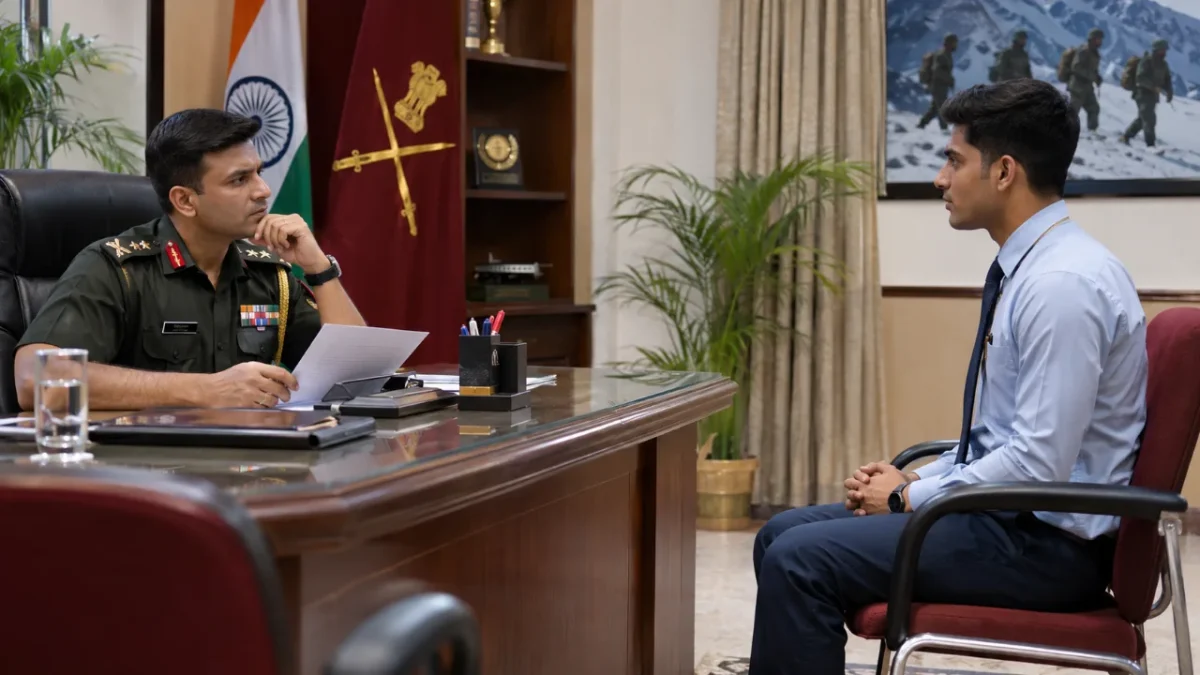
The SSB Interview is one of the most important stages of the selection process for candidates aspiring to become officers in the Indian Army, Indian Navy and Indian Air Force. Whether you are appearing through NDA, CDS, AFCAT, NCC Special Entry, TES or another eligible entry, preparing for commonly asked SSB Interview Questions and Answers can help you understand what to expect during your Personal Interview.

Unlike a conventional job interview, the SSB Personal Interview is not simply a test of general knowledge or communication skills. The Interviewing Officer (IO) seeks to understand your personality, background, decision-making ability, responsibilities, achievements, setbacks and motivation to serve in the Armed Forces.
Many questions are based on your Personal Information Questionnaire (PIQ), educational record, family, hobbies, friends and everyday activities.
This guide covers 120 important SSB Interview questions for 2026, categorized by topic, along with practical sample answers, rapid-fire questions, preparation strategies and common mistakes to avoid.
Important: These are representative preparation questions, not an official or guaranteed list of questions asked by the Services Selection Board. There is no universally correct answer to personal questions. Candidates should use the sample responses to understand how to organize their thoughts rather than memorize them.
What Is the SSB Personal Interview?
The Services Selection Board evaluates candidates for their suitability for officer training in the Indian Armed Forces through a comprehensive assessment process.
The SSB selection procedure generally comprises two stages.
Stage I — Screening
Candidates undergo the Officer Intelligence Rating (OIR) tests and the Picture Perception and Description Test (PPDT). Only candidates who qualify in Stage I continue to Stage II.
Stage II — Detailed Assessment
This stage includes psychological tests, Group Testing Officer (GTO) tasks, the Personal Interview and the conference. These activities are normally conducted over four days following screening.
The Personal Interview is conducted by an Interviewing Officer, who may ask questions about your past experiences, present responsibilities and future plans.
The assessment is holistic. The interview, psychology tests and group tasks provide different opportunities for assessors to understand the candidate’s personality and officer potential.
What Does the Interviewing Officer Look For?
The Interviewing Officer may explore qualities such as:
- Effective intelligence and practical reasoning
- Responsibility and initiative
- Cooperation and teamwork
- Social adaptability
- Effective communication
- Determination and perseverance
- Confidence and courage
- Emotional stability
- Organizing ability
- Integrity and self-awareness
- Motivation for military service
The most convincing evidence of these qualities comes from your real experiences, not from prepared claims.
120 Important SSB Interview Questions 2026
The following questions are divided into 12 categories to help NDA, CDS, AFCAT and other SSB aspirants prepare systematically.
1. Personal Background and Self-Introduction Questions (1–10)
- Tell me about yourself.
- What is the meaning of your name?
- Describe your hometown and its importance.
- What are your three biggest strengths?
- What are your weaknesses, and how are you improving them?
- How would your friends describe your personality?
- Describe your daily routine from morning to night.
- What is the biggest achievement of your life?
- Describe a personal failure and what you learned from it.
- Why do you think you are suitable for the Armed Forces?
Preparation tip: Prepare specific examples from your school, college, workplace, family and community. Avoid describing yourself only through adjectives such as hardworking, disciplined or confident.
2. Family Background Questions (11–20)
- Tell me about your family members and their occupations.
- What responsibilities do you perform at home?
- Who are you closest to in your family, and why?
- What qualities do you admire in your father?
- What qualities do you admire in your mother?
- How do you maintain your relationship with your siblings?
- What are the major challenges your family has faced?
- How does your family respond when you make mistakes?
- What have you learned from your parents?
- How does your family feel about your decision to join the Armed Forces?
Preparation tip: The IO may ask follow-up questions about your parents’ education, occupations, household responsibilities, financial circumstances and family relationships. Provide factual answers without trying to portray an unrealistically perfect family.
3. Educational Background Questions (21–30)
- Tell me about your educational journey.
- Why did you choose your academic stream?
- Which subject is your favourite, and why?
- Which subject do you find most difficult?
- Why did your marks increase or decrease between Class 10 and Class 12?
- Who was your favourite teacher, and what did you learn from them?
- What leadership responsibilities did you hold in school or college?
- Tell me about an academic project you completed.
- How do you manage your studies and extracurricular activities?
- What would you change about your school or college?
Preparation tip: Review the subjects, marks and achievements mentioned in your PIQ. Be prepared to discuss any significant gaps, inconsistencies or changes in academic performance.
4. Friends and Social Relationships (31–40)
- How many close friends do you have?
- Who is your best friend, and why?
- What qualities do you admire in your friends?
- How are you different from your best friend?
- What activities do you usually do with your friends?
- Have you ever had a disagreement with a friend? How did you resolve it?
- What would your friends say is your biggest weakness?
- Have you ever helped a friend during a difficult situation?
- How do you behave when your group disagrees with your opinion?
- What do you value most in a friendship?
Preparation tip: Use real incidents demonstrating cooperation, reliability, mutual respect and mature conflict resolution.
5. Hobbies, Sports and Extracurricular Activities (41–50)
- What are your hobbies?
- How did you develop an interest in your favourite hobby?
- How much time do you devote to your hobbies?
- What have your hobbies taught you?
- Which sports do you play regularly?
- What is your greatest sporting achievement?
- How do you maintain physical fitness?
- Which book have you read recently, and what did you learn from it?
- What activities do you participate in outside academics or work?
- How do you manage failure in sports or competitions?
Preparation tip: Every hobby mentioned in your PIQ may lead to detailed follow-up questions. If you mention cricket, for example, be ready to discuss your playing experience, preferred role, rules and relevant developments in the sport.
6. Motivation to Join the Armed Forces (51–60)
- Why do you want to join the Indian Armed Forces?
- Why do you want to become an officer?
- Why have you chosen the Army, Navy or Air Force?
- When did you first develop an interest in military service?
- What qualities should a good military officer possess?
- How is military life different from civilian employment?
- Are you prepared for transfers, separation from family and demanding service conditions?
- What do you understand by leadership?
- What is more important in leadership: authority or responsibility?
- What will you do if you are not recommended by the SSB?
Preparation tip: Understand your own reasons for choosing military service. Adventure, discipline, leadership, family inspiration and public service can all form part of a genuine motivation, but your explanation should reflect your actual experiences.
7. PIQ-Based and Rapid-Fire Questions (61–70)
- Tell me about your education from Class 8 to the present.
- Describe your academic performance and major achievements.
- Tell me about your closest friends and their ambitions.
- Describe your favourite teachers and why you admire them.
- Explain your hobbies, sports participation and extracurricular activities.
- Describe your family members, occupations and relationships.
- Tell me about the responsibilities you perform at home.
- Describe the important events that influenced your personality.
- Tell me about your previous competitive examination attempts.
- Explain your future career plans and how you intend to achieve them.
Preparation tip: The IO may combine several topics into one rapid-fire question. Listen carefully, remember the broad sequence and answer systematically. If you miss a part, politely ask the officer to repeat it rather than inventing an answer.
8. Defence Knowledge and Current Affairs Questions (71–80)
- Who are the current Chiefs of the Indian Army, Navy and Air Force?
- Who is the current Chief of Defence Staff?
- What are the main responsibilities of the Indian Army, Navy and Air Force?
- What is the difference between the Chief of Defence Staff and the three Service Chiefs?
- What do you know about the National Defence Academy and Indian Military Academy?
- What do you understand about the Agnipath recruitment scheme?
- What are some important defence developments in India during 2026?
- What is the importance of indigenous defence manufacturing?
- What do you know about India’s international military exercises?
- What are the major national and international security challenges facing India?
Preparation tip: Current appointments, government policies and defence developments can change. Verify the latest information from official government and Armed Forces sources immediately before your SSB.
For opinion-based current-affairs questions, explain the issue, present relevant facts, consider different perspectives and state a reasoned conclusion.
9. Situational Judgement and Decision-Making Questions (81–90)
- What would you do if you witnessed a road accident?
- What would you do if your friend was caught cheating in an examination?
- How would you handle a disagreement between two team members?
- What would you do if your team leader made a serious mistake?
- How would you organize a college event with limited resources?
- What would you do if you found someone’s lost wallet?
- How would you respond if you were given an unfamiliar responsibility?
- What would you do if your team failed to meet an important deadline?
- How would you handle an emergency during a trekking expedition?
- What would you do if a senior asked you to perform an unethical act?
Preparation tip: Explain practical actions rather than dramatic or unrealistic solutions. Consider safety, available resources, communication, teamwork, legal responsibilities and the consequences of your decisions.
10. Questions for Repeaters and Previously Not Recommended Candidates (91–100)
- How many times have you appeared for the SSB?
- What happened during your previous attempt?
- Why do you think you were not recommended?
- What have you improved since your last SSB?
- Which activity did you find most challenging in your previous attempt?
- What did you learn from your previous SSB experience?
- How did you respond to your previous non-recommendation?
- What changes have you made in your daily routine?
- How is your current preparation different from earlier attempts?
- What will you do if you are not recommended this time?
Preparation tip: Unless officially informed of a specific reason, candidates generally should not claim to know exactly why the board did not recommend them. Instead, discuss your own observations and genuine improvements.
11. Stress, Self-Awareness and Personality Questions (101–110)
- Why should we recommend you?
- What makes you different from other candidates?
- What is your biggest fear?
- Have you ever lied to your parents or teachers?
- Describe a situation when you lost your temper.
- What criticism have you received from your friends or family?
- What would you do if you failed despite working very hard?
- What is one decision you regret?
- How do you react when someone questions your abilities?
- What would you change about your personality?
Preparation tip: The purpose of preparation is not to eliminate every weakness or mistake from your story. Demonstrate that you can acknowledge limitations, accept feedback and take corrective action.
12. Leadership, Responsibility and Career Goals (111–120)
- Describe an occasion when you led a team.
- How do you motivate people who are unwilling to cooperate?
- Have you ever taken responsibility for someone else’s mistake?
- What would you do if your team disagreed with your decision?
- How do you prioritize tasks under pressure?
- Describe a situation where you solved a problem without being asked.
- How do you balance personal ambitions with team requirements?
- What does integrity mean to you?
- Where do you see yourself in the next five years?
- What responsibilities do you expect to handle as an officer in the Armed Forces?
Preparation tip: Prepare genuine examples involving initiative, teamwork, communication, perseverance and accountability. Leadership is not limited to holding a formal position.
SSB Interview Questions with Sample Answers
Below are examples showing how candidates can structure thoughtful responses. These answers are illustrations only and must be adapted to reflect real personal experiences.
1. Tell Me About Yourself
Sample answer:
“Sir, I am a graduate from [college name] and belong to [hometown]. My family consists of [brief family details]. I have been actively involved in [sports, hobbies or responsibilities]. During my education, I developed a strong interest in [relevant subjects or activities]. I am currently preparing for a career in the Armed Forces while continuing to work on my physical fitness, general awareness and personal development.”
What makes a good answer?
Keep the introduction relevant and concise. Cover your background, education, responsibilities, interests and current activities. Do not recite your entire PIQ unless asked.
2. Why Do You Want to Join the Armed Forces?
Sample answer:
“My interest in the Armed Forces developed through [a genuine experience or influence]. I am attracted to a career that combines responsibility, teamwork, continuous learning and service to the country. Through [a real school, college, NCC, sports or professional experience], I discovered that I enjoy working with teams and accepting challenging responsibilities. I want to develop these abilities further through military training and service.”
What makes a good answer?
Explain how your motivation developed and connect it to demonstrated interests and experiences. Avoid depending entirely on slogans or claims of patriotism without personal context.
3. What Are Your Strengths?
Sample answer:
“One of my strengths is reliability. During [a genuine event], I was responsible for [specific duty]. I planned the work, coordinated with others and completed the assignment. Another strength is my willingness to learn. When I find that I lack knowledge or a skill, I try to improve through practice and feedback.”
What makes a good answer?
Choose two or three genuine strengths and support them with observable behaviour.
4. What Is Your Biggest Weakness?
Sample answer:
“I sometimes spend too much time checking my work because I want to avoid errors. This has occasionally affected my speed. I have started setting realistic deadlines, identifying the most important tasks first and reviewing my work within a fixed time. I have noticed improvement, although I am still working on it.”
What makes a good answer?
Acknowledge a real limitation, explain its effects and describe measurable improvement. Avoid presenting an obvious strength as a disguised weakness.
5. Why Did Your Marks Decrease in Class 12?
Sample answer:
“My marks decreased from [percentage] in Class 10 to [percentage] in Class 12. The major reason was [your actual reason, such as difficulty adjusting to the syllabus or poor time management]. I recognized the issue and subsequently changed my study routine by [specific corrective action]. This helped me understand the importance of consistent preparation.”
What makes a good answer?
Take responsibility where appropriate. Avoid blaming teachers, parents or circumstances without explaining your own role and subsequent actions.
6. Tell Me About Your Family
Sample answer:
“There are [number] members in my family. My father works as [occupation], my mother is [occupation or role], and my siblings are [brief details]. We generally discuss important family decisions together. I contribute by [actual household responsibilities]. One important value I have learned from my family is [specific value supported by an example].”
What makes a good answer?
Be factual, respectful and specific about your relationships and responsibilities.
7. Who Is Your Best Friend and Why?
Sample answer:
“My best friend is [name], whom I have known for [period]. We became friends through [school, college, sports or another activity]. I appreciate [name’s] honesty and willingness to support others. We share an interest in [activity], although we differ in [a genuine characteristic]. We have helped each other during [real example].”
What makes a good answer?
Demonstrate that you understand your friends as individuals rather than using generic descriptions.
8. Why Were You Not Recommended in Your Previous SSB?
Sample answer:
“Sir, I was not recommended in my previous attempt. The board did not provide me with a specific reason, so I cannot state exactly why. However, while reviewing my own performance, I felt I could improve my [actual area]. Since then, I have worked on this by [concrete action]. I am approaching this attempt with greater experience and better self-awareness.”
What makes a good answer?
Do not invent reasons for the board’s decision. Show realistic reflection and personal development.
9. What Will You Do If You Are Not Recommended?
Sample answer:
“Joining the Armed Forces remains an important career goal for me. If I am not recommended, I will review my preparation, work on areas requiring improvement and consider another attempt if I remain eligible. At the same time, I will continue pursuing [a genuine educational or career plan] so that I keep developing professionally.”
What makes a good answer?
Demonstrate determination without presenting your life as directionless if one result does not go your way.
10. What Is Leadership?
Sample answer:
“I consider leadership to be the ability to guide and support people towards a common objective while accepting responsibility for the outcome. A good leader understands the task, communicates clearly, considers the abilities of team members and makes timely decisions. I experienced this during [genuine example], where I learned that listening and cooperation are as important as giving instructions.”
What makes a good answer?
Connect your definition to practical actions and lived experience.
11. How Would You Handle a Disagreement Within Your Team?
Sample answer:
“I would first understand the reason for the disagreement and hear the people involved. I would then focus the discussion on the common objective and consider practical solutions. If a decision had to be made urgently, I would communicate the reasoning clearly and help the team proceed. Afterwards, I would review whether the disagreement revealed a problem in planning or communication.”
What makes a good answer?
Show balanced judgement rather than assuming every disagreement requires authority or punishment.
12. What Would You Do If You Witnessed a Road Accident?
Sample answer:
“I would first assess whether the area was safe and avoid creating another accident. I would call the emergency services, provide the location and describe the situation. If it was safe, I would assist within my level of first-aid knowledge and seek help from others. I would avoid moving an injured person unnecessarily, unless there was an immediate threat requiring relocation.”
What makes a good answer?
Prioritize personal safety, emergency assistance, practical judgement and responsible action.
13. What Is Your Greatest Achievement?
Sample answer:
“One achievement I value is [real achievement]. It was important to me because [reason]. I faced [specific challenge] and worked on it through [actions]. The eventual result was [outcome]. More importantly, the experience taught me [lesson].”
What makes a good answer?
An achievement does not have to be a national-level award. Taking responsibility for your family, improving academically or completing a difficult project can also be meaningful when explained honestly.
14. Who Is Your Role Model?
Sample answer:
“One person I admire is [name] because of [specific actions or qualities]. I particularly respect [a verified example]. I have tried to apply a similar approach in my own life by [personal example]. I also recognize that every individual has strengths and limitations.”
What makes a good answer?
Know your chosen role model well. Avoid naming a famous military leader merely because it sounds impressive.
15. Why Should We Recommend You?
Sample answer:
“Sir, I believe my experiences have helped me develop qualities such as responsibility, cooperation and willingness to learn. For example, [specific experience]. I understand that becoming an officer requires continuous improvement and professional training. I am motivated to serve and prepared to work hard, although I recognize that my suitability is for the board to assess.”
What makes a good answer?
Be confident without claiming superiority over other candidates or implying that you already possess every quality required of an officer.
Rapid-Fire Questions in the SSB Personal Interview
Rapid-fire or comprehensive information questions are a common preparation topic among SSB aspirants.
Rather than asking only one short question, the Interviewing Officer may combine several questions relating to your education, family, friends, hobbies or personal achievements.
For example:
“Tell me about your schooling from Class 8 onwards, the subjects you liked, your academic performance, your favourite teachers, the activities you participated in, the responsibilities you held and the achievements you are proud of.”
The candidate is expected to listen attentively and respond in a logical sequence.
How to Answer Rapid-Fire Questions
First, listen to the complete question. Avoid interrupting the Interviewing Officer unnecessarily.
Second, identify the main themes. A question may cover education, extracurricular activities, teachers and achievements. Mentally organize these headings.
Third, answer in sequence. Begin with the first theme and progress naturally through the others.
Fourth, ask for clarification when necessary. If you forget a part of a long question, politely request that portion to be repeated.
Finally, avoid inventing information. It is better to acknowledge that you have missed or cannot recall something than to provide an incorrect answer.
How to Prepare Your PIQ Form for the SSB Interview
The Personal Information Questionnaire is an important source of information for the Interviewing Officer.
Candidates should carefully review the details they provide, including:
- Name, age, hometown and family information
- Parents’ occupations and educational backgrounds
- Academic results and institutions attended
- Sports participation and achievements
- Hobbies and extracurricular activities
- Positions of responsibility
- NCC participation, where applicable
- Previous SSB attempts and relevant examination details
- Current education, employment or career activities
For every significant PIQ entry, prepare for follow-up questions such as what you did, why you did it, what challenges you faced, what resulted and what you learned.
If you mention that you organized a college event, for example, be prepared to explain the number of participants, your exact responsibilities, the resources available, problems encountered and eventual outcome.
The aim is not to create elaborate stories. It is to understand and communicate your genuine experiences clearly.
Common Mistakes to Avoid During the SSB Interview
1. Memorizing Model Answers
Prepared answers may sound polished but often become difficult to maintain when the IO asks specific follow-up questions.
2. Exaggerating Achievements
Claiming to have led an event, won a competition or performed an activity that you did not actually complete can create inconsistencies.
3. Giving Incorrect Defence Information
Avoid guessing the names of serving officers, current military operations or policy changes. If uncertain, acknowledge the limitation rather than presenting speculation as fact.
4. Blaming Others for Failures
A mature candidate can explain external circumstances while also recognizing personal responsibilities and opportunities for improvement.
5. Speaking Without Listening
Candidates should listen to the question before deciding how much detail to provide.
6. Presenting a Perfect Personality
The SSB assesses real people. Candidates do not need to claim they have never failed, lost their temper or made a mistake.
7. Confusing Confidence With Aggression
Confidence means expressing ideas clearly and respectfully. It does not mean interrupting, arguing unnecessarily or dismissing another perspective.
8. Neglecting Current Affairs
Candidates should follow important national, international, defence, economic and scientific developments while developing reasoned views on major issues.
Seven-Day SSB Personal Interview Preparation Plan
| Day | Preparation Focus |
|---|---|
| Day 1 | Review your PIQ and prepare your personal introduction |
| Day 2 | Prepare family, friends, responsibilities and education-related questions |
| Day 3 | Revise hobbies, sports, books and extracurricular experiences |
| Day 4 | Study the Armed Forces, your preferred service and recent defence developments |
| Day 5 | Practise rapid-fire questions and real-life examples of leadership and responsibility |
| Day 6 | Conduct a mock interview and review clarity, accuracy and self-awareness |
| Day 7 | Revise important points, check current affairs and organize travel and documentation |
This is a practice schedule, not an official training requirement. Candidates can adapt it to their experience and available time.
Frequently Asked Questions About SSB Interview Questions
What are the most commonly asked questions in the SSB Personal Interview?
Common preparation topics include self-introduction, family background, education, friends, hobbies, responsibilities, achievements, weaknesses, motivation for joining the Armed Forces and current affairs. The questions vary with each candidate’s background.
How many questions are asked in an SSB Personal Interview?
There is no fixed number of questions. An interview may include a mixture of direct questions, detailed follow-ups and comprehensive rapid-fire questions. The number depends on the discussion and the Interviewing Officer’s assessment needs.
How long does the SSB Personal Interview last?
The duration varies, but candidates often describe interviews lasting approximately 30–60 minutes. Actual interview duration can be shorter or longer, and the length alone does not establish whether a candidate will be recommended.
Are SSB Interview questions the same for NDA, CDS and AFCAT candidates?
Many broad topics overlap because all candidates undergo an officer-suitability assessment. However, questions can differ according to age, education, entry scheme, previous experience and the service for which the candidate is being considered.
What should I do if I do not know an answer in the SSB Interview?
Remain composed and state that you do not know or cannot recall the answer. Avoid bluffing. If the question is unclear, politely ask for clarification.
Are current affairs important in the SSB Interview?
Yes. Candidates may be asked about major national and international events, defence developments, sports, government policies or issues affecting society. Understanding events and being able to discuss them thoughtfully is more useful than memorizing headlines alone.
Can I prepare for the SSB Interview without coaching?
Yes. Candidates can prepare independently by reviewing their PIQ, reflecting on their experiences, reading widely, following current affairs, maintaining fitness and practising communication. Coaching is not an official requirement for appearing in the SSB.
Are sample answers enough to clear the SSB Interview?
No. Sample answers can help candidates organize their thoughts, but SSB selection depends on a broader assessment of personality and officer potential through multiple assessment techniques.
Final SSB Interview Preparation Tips
The best way to prepare for SSB Interview questions is to understand yourself, your responsibilities, your achievements, your mistakes and your reasons for wanting to join the Armed Forces.
Study your PIQ carefully, maintain awareness of important developments, speak clearly and practise explaining real events from your life.
Remember that the SSB Personal Interview is not a competition to deliver the most polished answer. It is an opportunity to communicate your personality, judgement, motivation and experiences honestly.
Use these 120 SSB Interview Questions and Answers for 2026 as a structured practice resource, but build your responses around your own experiences.
Prepare thoroughly, remain authentic and approach the interview with confidence.
Jai Hind!